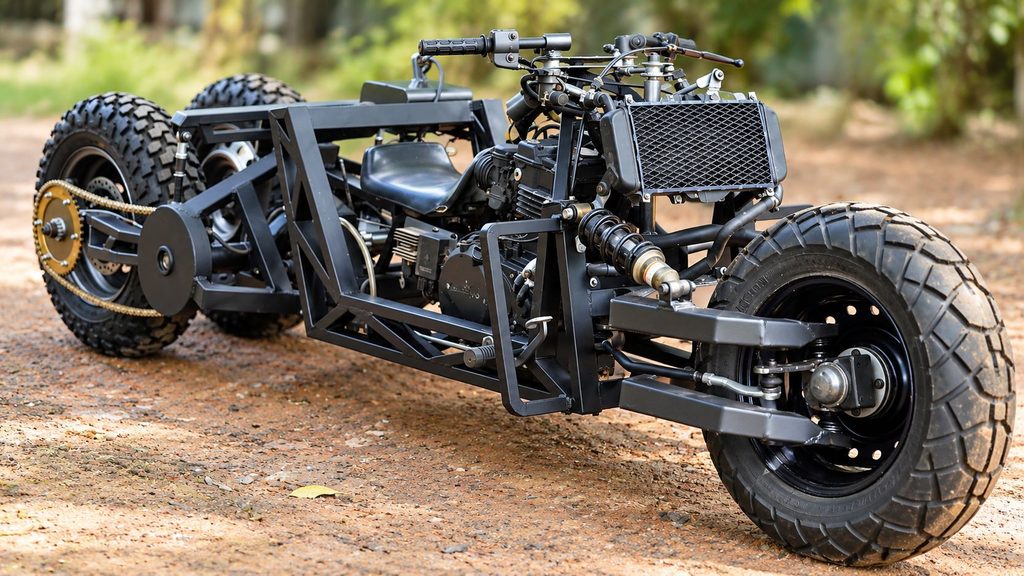
What happens when you take a 1996 Kawasaki ER5 motorcycle engine, build a completely custom chassis around it, add two rear wheels that can lean with the bike, and give the machine reverse gear?
The result is my Kawasaki ER5 Tilting Trike — a one-of-a-kind custom three-wheel motorcycle with a design that looks surprisingly close to a futuristic Batpod.
This project was built almost completely from scratch, with custom fabrication, machining, suspension work, steering components, a modified differential, a custom rear tilting mechanism and a chain-driven drivetrain.
The most unusual part is simple to see but complicated to build: the two rear wheels tilt together with the motorcycle when it leans into a turn.
Kawasaki ER5 Tilting Trike – The Main Concept
This Kawasaki ER5 Tilting Trike uses a unique three-wheel layout:
- One front wheel
- Two rear wheels
- Both rear wheels tilt with the motorcycle
- 1996 Kawasaki ER5 engine
- Integrated engine gearbox
- Reverse gear
- Custom steel chassis
- Front and rear suspension
- Rear disc brake
- Chain-driven rear differential
- 180/80-14 tyres
- 18 cm ground clearance
- 50 cm seat height
Unlike a conventional trike, the rear wheels are not fixed upright when the motorcycle leans. The custom linkage system allows the rear wheels to follow the lean angle of the main chassis.
The goal was to create something that still feels visually and mechanically closer to a motorcycle while having three wheels.
The Batpod-Style Design
One of the first things people notice about this build is its appearance.
After painting the entire chassis black, the low and aggressive shape of the motorcycle gave it a very unusual futuristic look.
To me, the final design has a strong Batpod-style appearance.
It is not a replica of Batman’s Batpod. Instead, the design naturally developed into a similar dark, mechanical and aggressive shape.
The exposed frame, large tyres, low seating position, black finish and wide rear section all contribute to that appearance.
The finished machine looks especially different when viewed from the front and rear.
1996 Kawasaki ER5 Engine
At the heart of the build is a 1996 Kawasaki ER5 engine.
The engine and gearbox are one integrated unit, so there is no separate gearbox used in this project.
The Kawasaki engine was mounted into the custom-built chassis and positioned to achieve a practical balance between the engine, rider and rear drivetrain.
The engine gives this homemade three-wheel motorcycle a very different character compared with small-engine trikes.
I have not tested the maximum speed because I do not currently have a suitable race track or safe location for a top-speed test.
However, on a normal road, the motorcycle can comfortably reach around 100 km/h.
The actual maximum speed remains untested.
Custom Steel Chassis
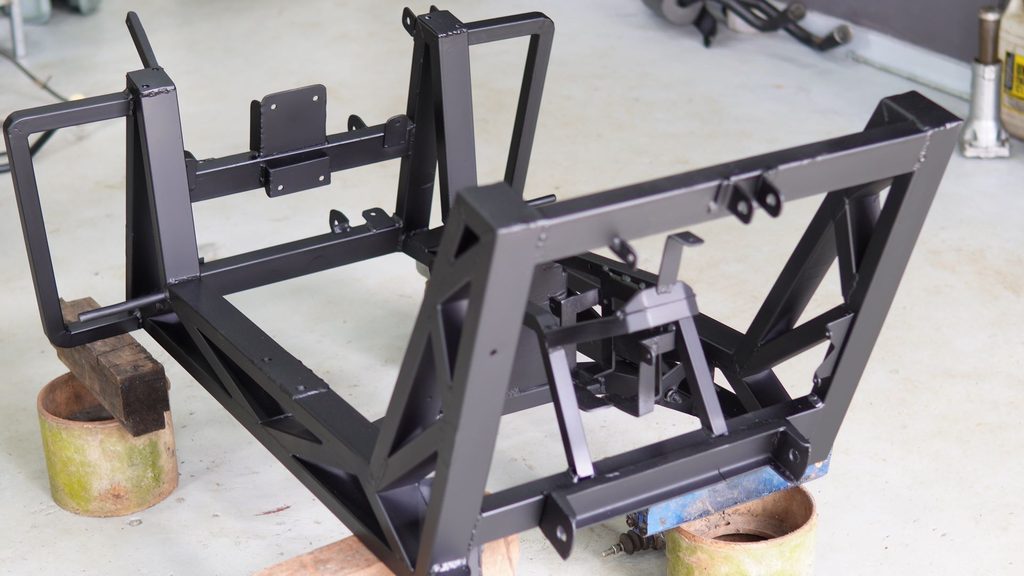
The main chassis was fabricated from 1 × 2 inch box section steel with a wall thickness of approximately 1.6 mm.
The chassis was designed around the Kawasaki ER5 engine, the rider position, front suspension and rear tilting mechanism.
Because this is a custom-built machine, the frame had to be designed around the components rather than simply modifying an existing motorcycle frame.
Many parts of the chassis were cut, positioned, welded and adjusted during the build.
The result is a low and wide structure that supports the engine, suspension, drivetrain and rear tilting system.
Kawasaki ER5 Tilting Trike Rear Wheel System
The most interesting engineering feature of this Kawasaki ER5 Tilting Trike is the rear tilting mechanism.
There are two rear wheels, but they are not independently fixed to a conventional solid axle.
Each rear wheel has its own custom swing arm.
The two swing arms are connected through a linkage system that allows both wheels to follow the movement of the motorcycle.
When the motorcycle leans to the left, the rear wheels lean to the left.
When the motorcycle leans to the right, the rear wheels lean to the right.
This gives the rear of the trike a motorcycle-like leaning movement.
Custom Rear Swing Arms
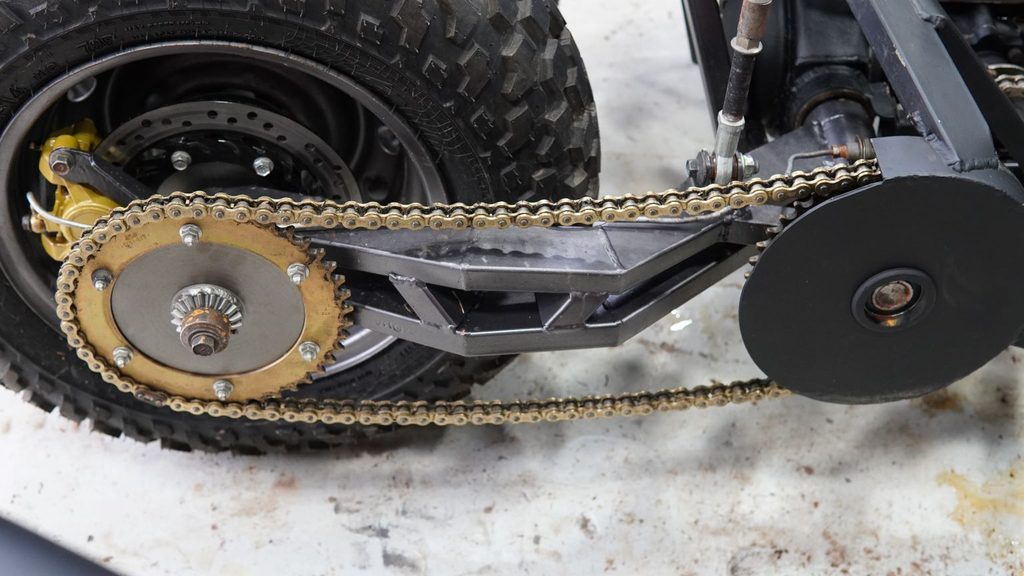
Each rear wheel uses a separate custom swing arm.
The swing arms were fabricated from steel and designed around the rear hubs, suspension and tilting mechanism.
The rear hub-to-swing-arm pivot distance is approximately 54 cm.
The rear wheel centre-to-centre distance is approximately 45 cm.
Each rear hub uses 6206 2RS bearings, with two bearings supporting each hub.
The rear wheels use 180/80-14 tyres, giving the motorcycle a wide and aggressive appearance.
Rear Tilting Linkage Mechanism
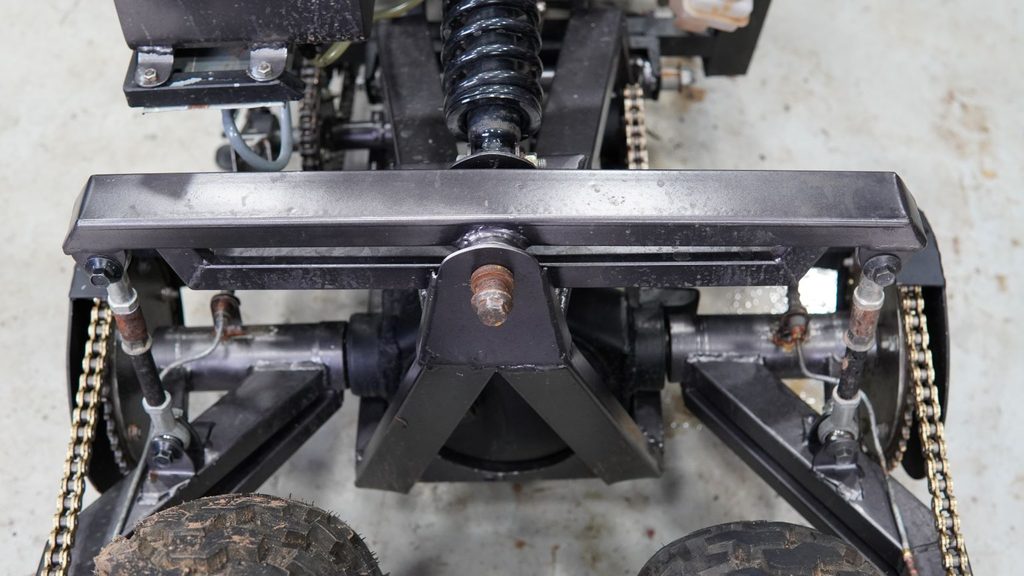
The rear tilting system uses custom linkage bars and a crossbar.
Two linkage bars are approximately 21 cm long.
The linkage bars connect the rear swing arms to a central crossbar.
The crossbar is approximately 54 cm long, with its pivot positioned in the centre.
The linkage attachment point on each rear swing arm is approximately 14 cm from the swing-arm pivot.
This geometry allows movement from the central chassis into the two rear swing arms.
The result is synchronized movement of both rear wheels.
How the Rear Wheels Lean
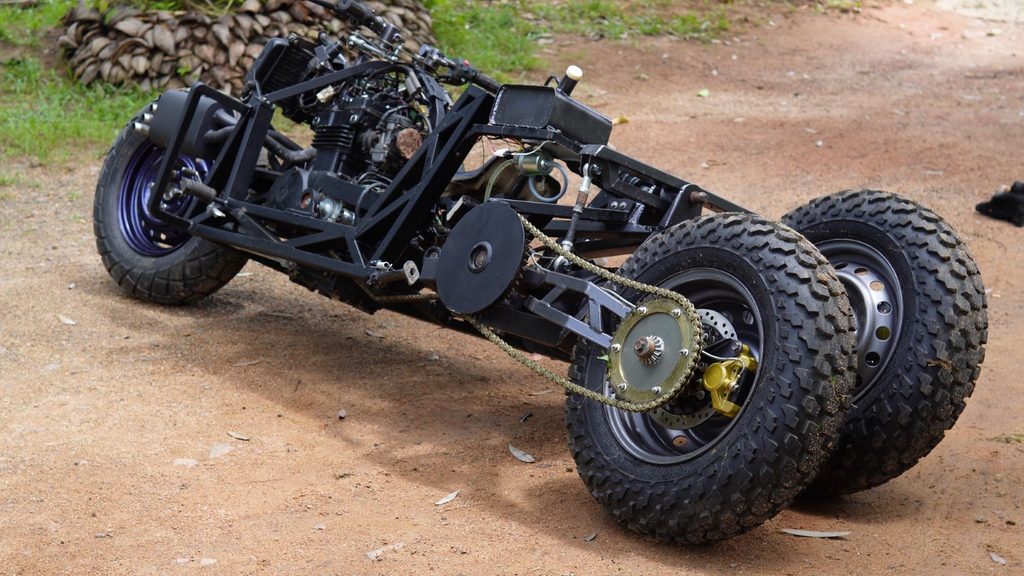
The operation of the system is easier to understand while watching the motorcycle move.
When the rider leans the motorcycle to one side, the main chassis moves relative to the rear suspension.
The linkage transfers this movement to the two rear swing arms.
Both rear wheels then change their angle together.
This means the rear wheels do not simply remain vertical while the chassis leans.
Instead, the entire rear wheel assembly follows the motorcycle’s leaning movement.
This is the key feature that makes this Kawasaki ER5 Tilting Trike different from a conventional three-wheel motorcycle.
Rear Suspension
The rear section uses a single mono shock absorber.
The mono shock works with the custom swing arms and rear tilting mechanism to control the vertical movement of the rear wheels while allowing the entire rear assembly to tilt with the motorcycle.
The rear suspension system therefore has to handle two different types of movement:
Suspension movement as the rear wheels travel up and down.
Tilting movement as the motorcycle leans from side to side.
Combining these two movements into one compact rear assembly was one of the more challenging parts of the build.
Modified Differential and Reverse Gear
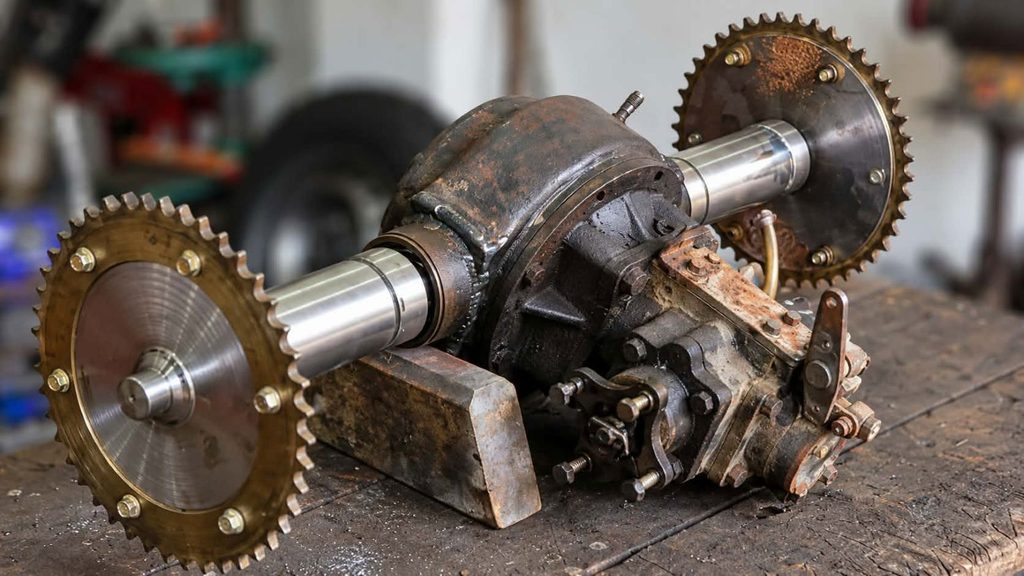
Another unusual feature is the rear differential.
The differential was originally sourced from a Chinese tricycle and heavily modified for this project.
The differential provides drive to both rear wheels while allowing them to rotate at different speeds when necessary.
The differential also has reverse gear.
This is particularly useful because the finished motorcycle is large and relatively long.
Having reverse makes manoeuvring the machine much easier than trying to push it manually.
Three-Stage Chain Drive
The drivetrain uses a multi-stage chain system.
The basic layout is:
Kawasaki ER5 Engine → Jackshaft → Differential → Rear Wheels
The engine does not drive the differential directly.
Instead, the engine drives a separate jackshaft.
The jackshaft then transfers power to the differential, and the differential sends power to the two rear wheels.
The drivetrain uses 520 chain.
The differential input uses a 14T sprocket, while the jackshaft uses a 13T sprocket.
The rear wheel drive uses a 45T sprocket.
This arrangement allowed the engine and differential positions to be separated while keeping the overall chassis layout practical.
Custom Jackshaft
A separate jackshaft was necessary because the engine output and differential input positions did not line up directly.
The jackshaft acts as an intermediate power-transfer point.
It uses two 6204 2RS bearings mounted into custom brackets.
This arrangement provides support for the shaft while allowing the chain drive to transfer engine power toward the differential.
The jackshaft also helped make the overall drivetrain layout possible within the limited space of the custom chassis.
Rear Disc Brake
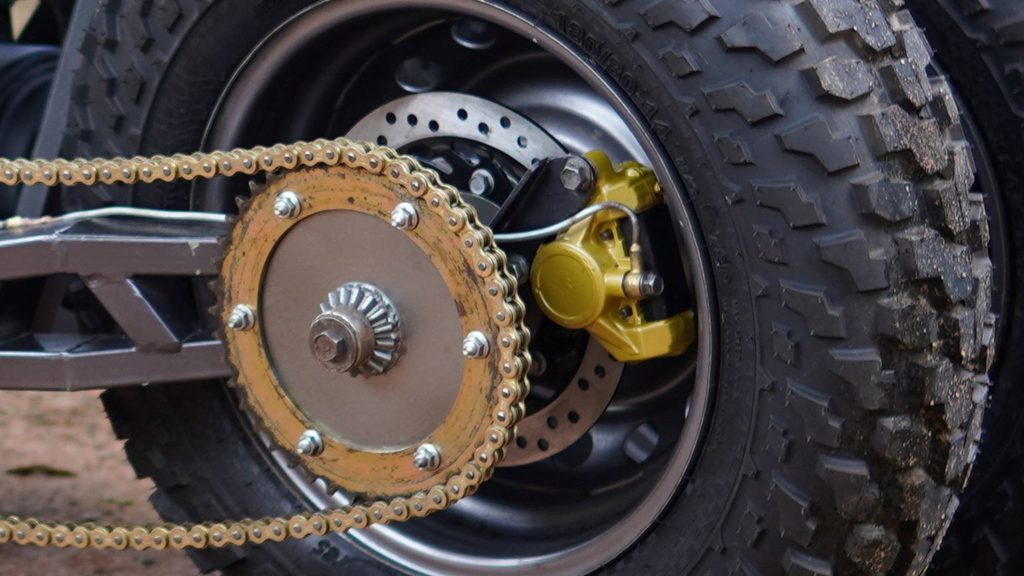
The rear braking system uses a disc brake.
The brake disc mounting system was custom-made as part of the rear hub and axle fabrication.
The rear axle itself was also heavily modified and machined to suit the custom wheels and hub arrangement.
The brake system was positioned around the rear wheel assembly while keeping enough clearance for the chain and suspension components.
Custom Rear Axles and Hubs
The rear hubs were not simply taken from an existing motorcycle and bolted into place.
The rear axle system was fabricated and machined specifically for this project.
Parts of differential axle shafts were modified and welded with additional steel sections.
The ends were then machined on a lathe to achieve the required dimensions for the wheel and bearing arrangement.
This combination of welding and machining allowed the rear hubs to be adapted to the custom chassis.
Front Wheel and Suspension
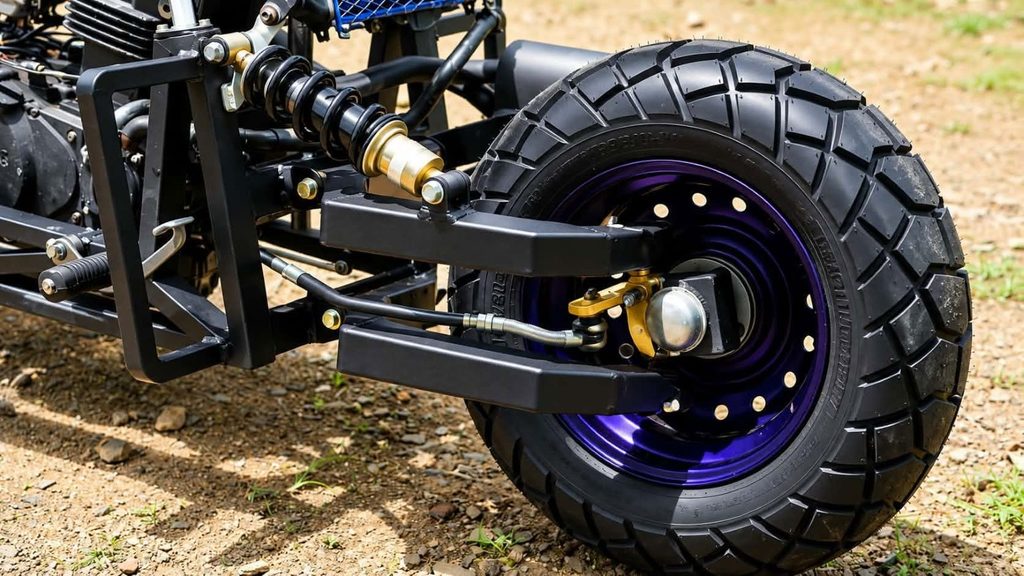
The motorcycle uses one front wheel.
The front hub was built using a vehicle hub and bearing housing that was machined to suit the custom front suspension.
The front suspension uses a custom double-arm arrangement with upper and lower arms connected to the front hub.
The front hub offset is approximately 51 mm.
The front rake angle is approximately 26 degrees.
Two front shock absorbers are used to control the front suspension movement.
Custom Steering System
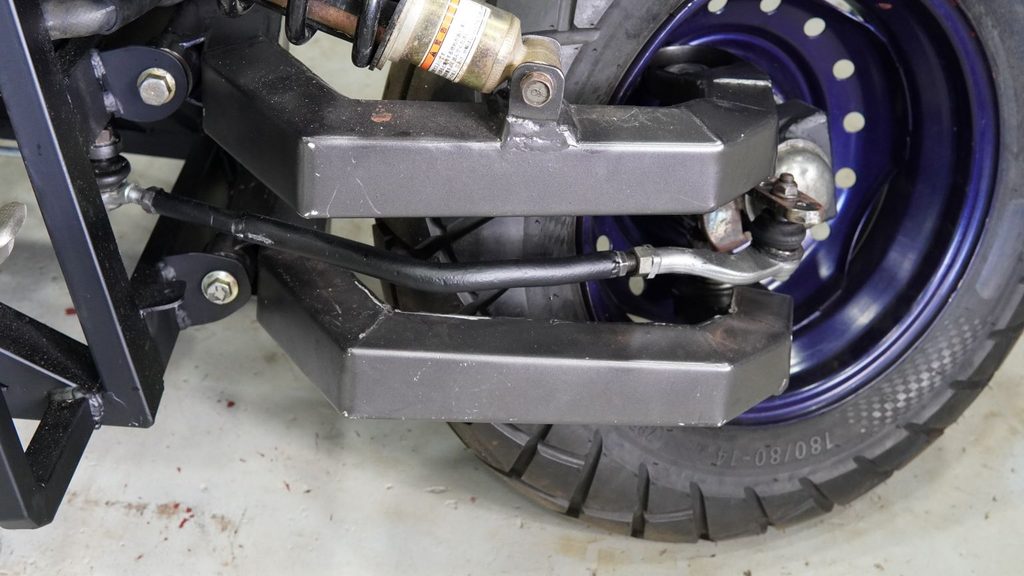
The steering system was also fabricated specifically for this motorcycle.
Two tie rods connect the steering arms on the front hub to the upper steering mechanism.
The upper steering shaft then connects to the handlebar system through custom linkages and eye bearings.
The complete steering system was designed and assembled around the custom front suspension rather than using a conventional motorcycle front fork.
This was another major part of the fabrication process.
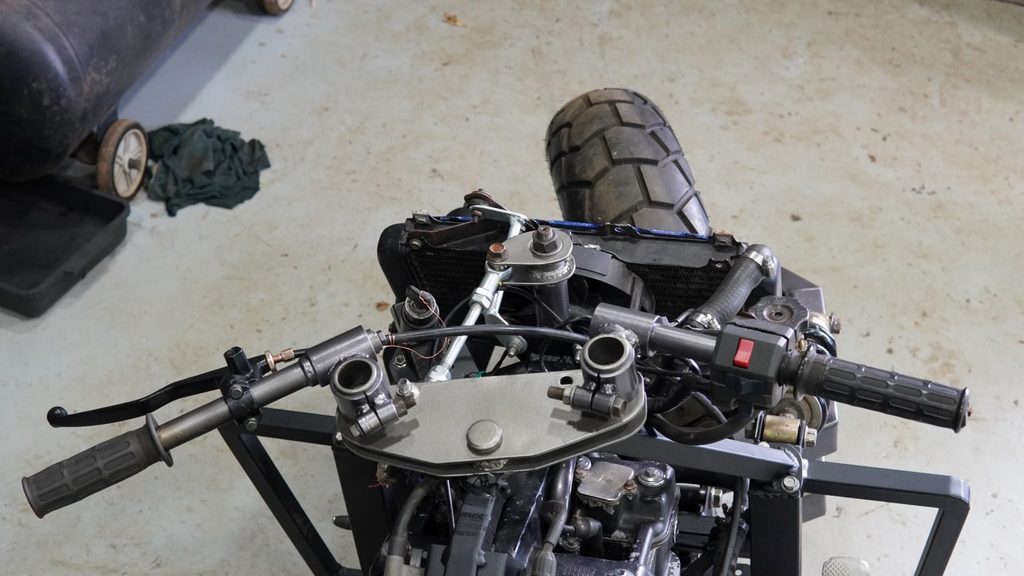
Kawasaki ER5 Tilting Trike Wheel and Tyre Setup
The motorcycle uses 180/80-14 tyres.
The front and rear tyres are the same size, giving the finished machine a very distinctive appearance.
The rear wheels use 14-inch rims.
The large tyres also contribute to the aggressive Batpod-style appearance of the motorcycle.
The wide rear section makes the machine look much larger than a conventional motorcycle.
Ground Clearance and Off-Road Potential
The current ground clearance is approximately 18 cm.
This gives the motorcycle a reasonable amount of clearance for uneven surfaces and light off-road riding.
If more off-road capability is required, the rear section can be raised further.
The suspension and chassis arrangement leave room for future adjustment depending on how the motorcycle will ultimately be used.
Rear-Mounted Fuel Tank
The fuel tank was mounted toward the rear of the motorcycle.
Because of the custom chassis and engine layout, the fuel system had to be designed around the available space.
Fuel is supplied to the carburetor using an electric fuel pump.
This arrangement allowed the fuel tank to be positioned at the rear while still providing fuel to the engine.
Front-Mounted Radiator
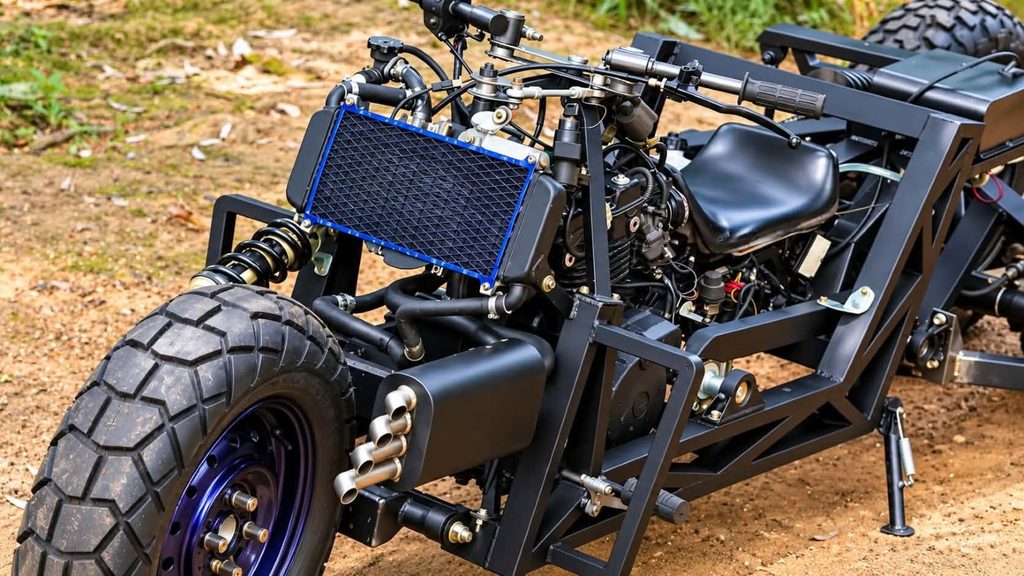
The radiator was mounted at the front of the motorcycle.
This position provides direct exposure to incoming airflow while the motorcycle is moving.
The radiator position also helped keep the engine cooling system separate from the rear drivetrain and suspension components.
Custom Front-Mounted Exhaust and Silencer
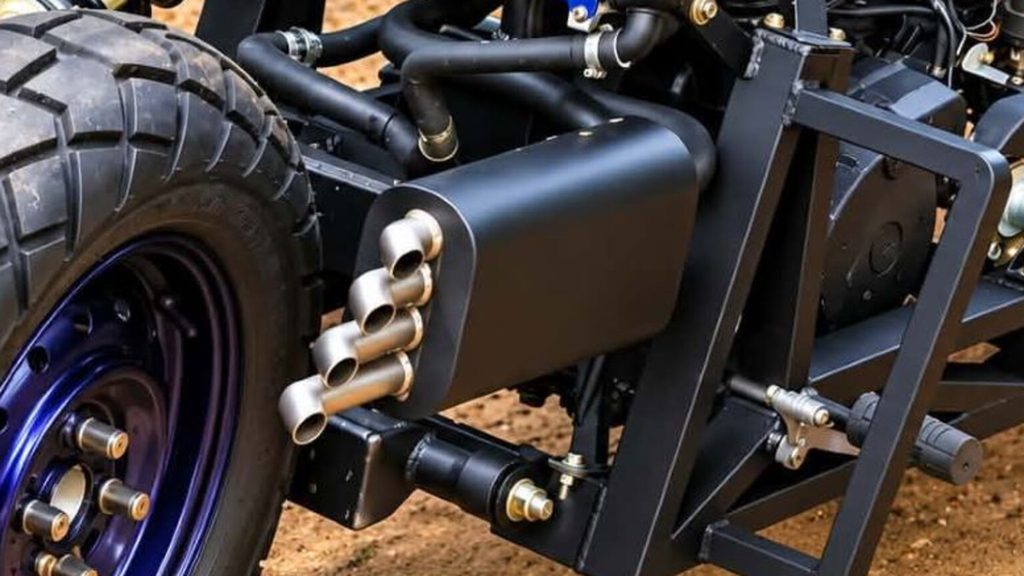
One of the most distinctive parts of the Kawasaki ER5 tilting trike is its custom-built exhaust and silencer system.
Instead of placing the silencer in the conventional rear position, the exhaust system was designed and mounted at the front section of the motorcycle. The entire silencer assembly was handmade specifically for this build, allowing the exhaust system to match the custom chassis and overall design of the trike.
The two exhaust pipes from the Kawasaki ER5 engine are routed into the custom silencer body. Inside the handmade silencer, the exhaust flow is combined and redirected before exiting through four smaller outlet pipes.
The four compact exhaust outlets give the system a unique appearance and make it one of the most visually distinctive details of the motorcycle. The outer silencer body was also fabricated to fit neatly into the available space at the front of the chassis while maintaining clearance around the front wheel, suspension and steering components.
This exhaust system was not simply adapted from an existing motorcycle. It was designed, fabricated and fitted as a complete custom component specifically for this project.
Low 50 cm Seat Height
The seat height from the ground is approximately 50 cm.
This is relatively low for a motorcycle of this size and contributes to the aggressive, low-profile appearance.
The low seating position also works well with the wide rear section and long chassis.
Together, these features give the motorcycle its unusual Batpod-style silhouette.
235 cm Wheelbase
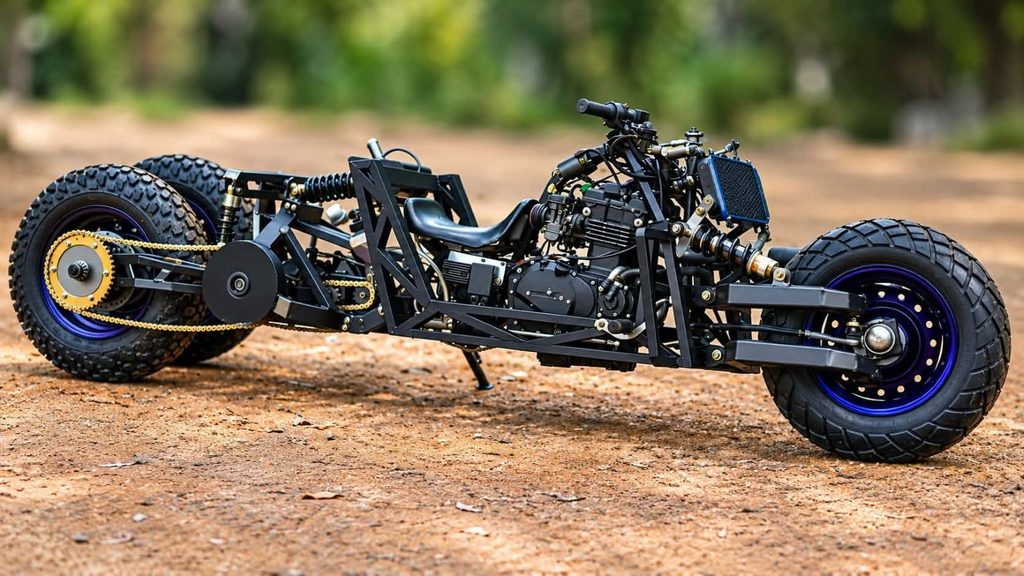
The current wheelbase, measured from the front wheel centre to the rear wheel centre, is approximately 235 cm.
The long wheelbase gives the motorcycle a large visual presence.
It also provided enough space to position the Kawasaki ER5 engine, rider, fuel tank, differential, jackshaft and rear tilting mechanism.
The final dimensions were developed through the actual fabrication process rather than being based entirely on a pre-existing motorcycle frame.
Black Paint and Final Appearance
After the fabrication and mechanical work, the chassis and major components were painted black.
The black finish completely changed the appearance of the machine.
Combined with the large tyres, low seat, exposed mechanical components and wide rear section, the finished motorcycle has a very aggressive futuristic appearance.
This is where the Batpod-style character became especially noticeable.
It was not designed as an exact Batpod replica, but the final shape definitely has that kind of visual character.
Building the Kawasaki ER5 Tilting Trike From Scratch
One of the most important parts of this project was not simply assembling existing motorcycle parts.
A large amount of the machine had to be designed, fabricated, modified and machined specifically for this build.
The project included:
- Custom steel chassis fabrication
- Engine mounting
- Custom front hub
- Front suspension fabrication
- Custom steering system
- Rear swing-arm fabrication
- Rear hub construction
- Differential modification
- Jackshaft fabrication
- Chain-drive alignment
- Rear tilting linkage
- Suspension installation
- Brake installation
- Fuel system
- Radiator installation
- Welding and machining
- Final painting and assembly
Every major system had to work together within the same chassis.
What Makes This Kawasaki ER5 Tilting Trike Different?
There are several features that make this project unusual.
It has one front wheel and two rear wheels, but the rear wheels lean with the motorcycle.
It uses a 1996 Kawasaki ER5 engine with its integrated gearbox.
It has a modified differential with reverse gear.
It uses a separate jackshaft between the engine and differential.
It has a custom suspension and steering system.
It has approximately 18 cm ground clearance.
And after everything was painted black, the final machine developed a distinctive Batpod-style appearance.
The combination of all these features makes this more than simply a three-wheel motorcycle.
Road Testing the Kawasaki ER5 Tilting Trike
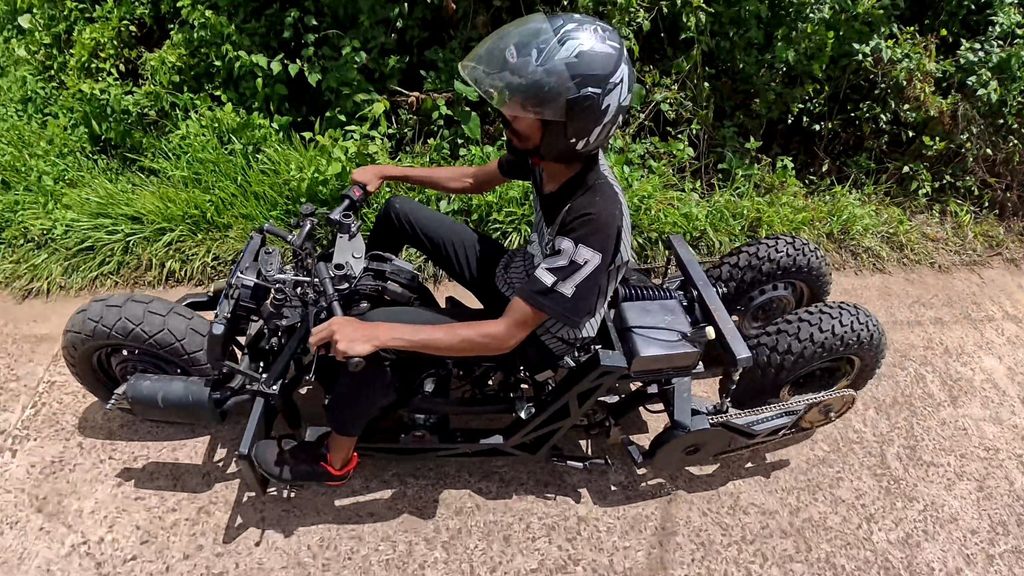
After completing the mechanical systems, the motorcycle was tested on the road.
The main purpose of the testing was to check the behaviour of the steering, suspension, drivetrain and rear tilting mechanism.
The maximum speed was not tested because there was no suitable race track available for a safe top-speed test.
However, the motorcycle can comfortably travel at around 100 km/h on a normal road.
Further testing would be required to determine the actual maximum speed under controlled conditions.
Final Thoughts
Building this Kawasaki ER5 Tilting Trike was a combination of motorcycle engineering, fabrication, machining and experimentation.
The biggest challenge was not simply making a three-wheel motorcycle.
The real challenge was creating a rear system where both rear wheels could lean with the motorcycle, while also incorporating suspension, differential drive, reverse gear and a practical chain-drive system.
The final result is a custom machine with a very different personality from a normal motorcycle.
With its black finish, low 50 cm seat, wide 180/80-14 tyres, long 235 cm wheelbase and aggressive frame design, it has a strong Batpod-style appearance.
But underneath that appearance is a fully functional custom mechanical system built around a 1996 Kawasaki ER5 engine.
This is the complete build story of my Kawasaki ER5 Tilting Trike.
More detailed photos and videos of the fabrication, machining, suspension, drivetrain and testing will show how each part of this unusual motorcycle was built.
Project Specifications
| Specification | Details |
| Project | Kawasaki ER5 Tilting Trike |
| Engine | 1996 Kawasaki ER5 |
| Gearbox | Integrated with engine |
| Layout | 1 front wheel + 2 rear wheels |
| Rear system | Tilting / leaning |
| Reverse | Yes |
| Front tyre | 180/80-14 |
| Rear tyres | 180/80-14 |
| Rear wheel spacing | 45 cm centre-to-centre |
| Wheelbase | 235 cm |
| Front rake | 26° |
| Front hub offset | 51 mm |
| Rear swing-arm length | 54 cm |
| Ground clearance | 18 cm |
| Seat height | 50 cm |
| Main chassis | 1 × 2 inch box section |
| Chassis wall thickness | 1.6 mm |
| Rear brake | Disc brake |
| Differential | Modified tricycle differential |
| Drive chain | 520 |
| Differential sprocket | 14T |
| Jackshaft sprocket | 13T |
| Rear wheel sprocket | 45T |
| Fuel delivery | Electric fuel pump |
| Fuel tank | Rear mounted |
| Radiator | Front mounted |
| Finish | Black |